
New betting sites in Kenya usually reach you before you go looking for them: an SMS, an advert in a timeline, a link from someone who signed up last week. This page is about what you can do with that single unfamiliar name in the half hour before you deposit anything, which is a narrower job than comparing a field of operators and a more answerable one. How the Kenyan market is organised as a whole, who licenses operators and where offshore sites sit inside it, is the subject of our overview of betting sites in Kenya. What follows starts one step later, with the name already in front of you and a decision to make about it.
Does “new” mean a new company, or only new to you?
Usually the second, and the two are worth separating before anything else. A site can be unfamiliar here and years old elsewhere, or genuinely weeks old, or an established company trading under a fresh brand, and from the homepage the three are indistinguishable. Which of the three you are looking at decides what every other check below can tell you, so it is the one to settle first.
Two features of the Gambling Control Act, 2025 (No. 14 of 2025) matter when you are looking at something that launched recently. First, a licence attaches to a company, not to a brand or a domain, so a shiny new name can sit on top of an old licensed company or on top of nothing at all. Second, section 79 of the Act only allows a foreign operator to be licensed for online gambling in Kenya if it is registered in Kenya and has a physical address registered here. That is a real bar, and it is the reason a large international bookmaker can be perfectly legitimate in its home market and still hold no Kenyan licence.
Which company is behind the brand, and is it on the register?
Kenya’s list of registered betting sites is a list of companies and not of brands, so this check starts in the small print of the site rather than on its homepage. There is exactly one list worth checking and it belongs to the regulator: the Gambling Regulatory Authority’s licensed-operators page.
The mechanics of that search, including the licence categories and why you have to search the registered company name rather than the brand on the app, are set out step by step in our guide to checking licensed betting companies in Kenya. The rest of this page assumes you have run that check on a new site and come back with nothing, which is the point where an unfamiliar name stops behaving like an established one.
What does it mean if a new site is not on the list?
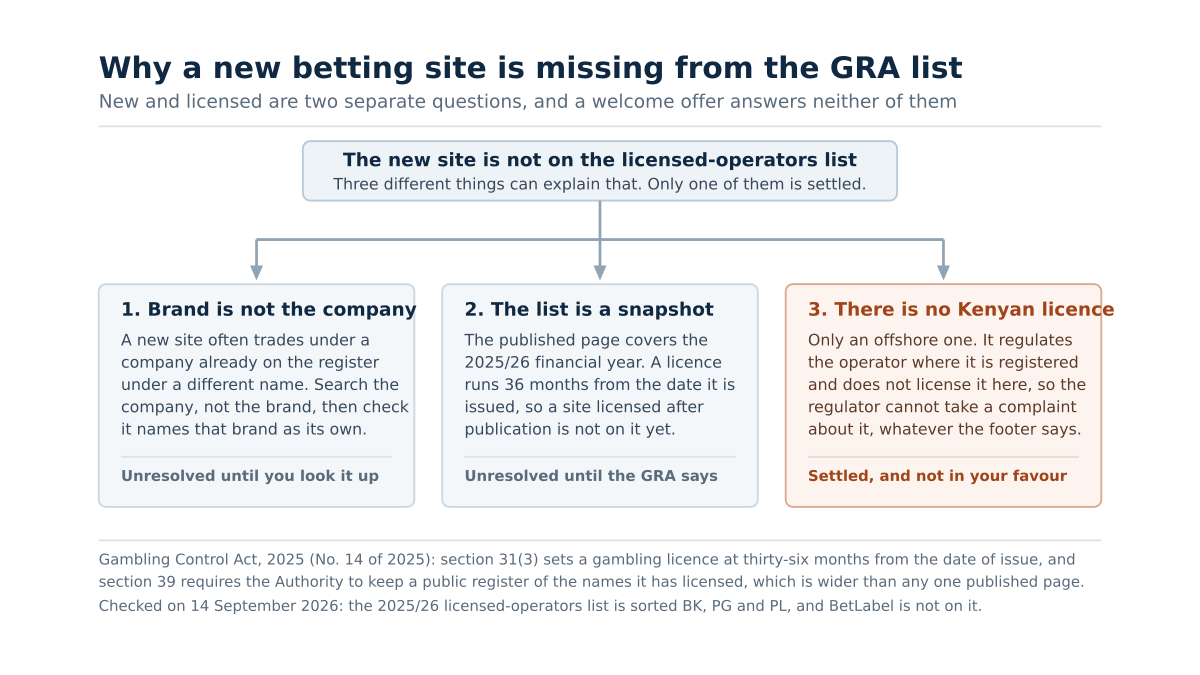
This is where a new entrant differs from an established one, and it is the part every “top 10 new betting sites” round-up skips. A blank result has three possible explanations, and only one of them is settled.
The brand is not the company. A new betting brand may belong to a company that is already on the register under a name nobody markets. Search the company named in the site’s terms and conditions or its “about” page, then confirm that company actually names that brand as one of its own. A matching company with no mention of the brand is not a match.
The published page is a snapshot. The list covers a financial year, but section 31(3) of the Act sets a gambling licence at thirty-six months from the date of issue. Those two cycles do not align, so a company licensed after the page was compiled will not be on it yet. Section 39 is the route through this: it requires the Authority to keep a register of the names it has licensed, their activities, counties and expiry dates, and that register is open to the public. If a site’s absence is the only thing standing between you and depositing, ask the Authority rather than guessing.
There is no Kenyan licence. A site in this position often holds an offshore licence instead, Curacao being a common one. An offshore licence is a real thing, but it regulates the operator in the place that issued it. It does not license that operator in Kenya, and no amount of it appearing in a website footer changes that.
The first two are questions you can close with a search or an email. The third one you cannot close at all, because it is already closed.
Why does a brand new betting site look finished on day one?
Because much of it was not built for that site. A new sportsbook is frequently not built from scratch at all: it runs on a shared white-label platform, where one company supplies the odds feed, the bet slip, the payments layer and the back office, and the new brand supplies a logo, a domain and a marketing budget. That is why a site nobody had heard of last month can offer dozens of sports, live in-play markets and a working Android build immediately.
It is worth naming because of what it means for your judgement. The polish of the product is evidence about the platform vendor, not about the company taking your deposit. Two brands on the same platform can be identical to use and completely different in who is legally responsible when a withdrawal stalls. BetLabel is a case in point: the operator serves its static assets from a shared platform CDN also used by several large international bookmakers, which is visible in the page source of its own site, and which says nothing either way about its licensing.
The same reasoning applies on the phone. A new site’s Android app often arrives as a direct APK download rather than through Google Play, and the reasons for that, along with what Android’s own signature check can and cannot tell you, are covered in our piece on choosing a betting app in Kenya.
Is the welcome bonus a reason to join a new site?
It is the loudest thing on the page and the least informative. A new brand has no reputation to trade on, so an offer is the only differentiator it can produce quickly. The size of one tells you about a marketing budget, not about the company behind it.
It also helps to know what a wagering requirement actually does. A matched deposit is not cash: it is a balance you have to turn over a set number of times before anything can be withdrawn, and the terms usually restrict which bets count. A common condition is that only accumulators of three or more selections qualify, sometimes with a minimum price on each leg. That condition is doing real work, because an accumulator of three legs is much less likely to land than any one of them, so the turnover is slower and more of it is lost along the way than the headline suggests. None of this is hidden. It is in the terms, and reading them before the offer is the whole skill.
A licensed site’s offer and an unlicensed site’s offer can look identical. The difference sits entirely in what happens afterwards, which is the next question.
What can you not check on a site that launched last month?
Its record, and that gap is unavoidable rather than suspicious. A site three weeks old has no payout history, no pattern of dispute outcomes and no accumulated complaints, so the usual signals are simply absent. This is true even when the licence checks out.
What the licence changes is what you can do when something goes wrong. A company on the register answers to a regulator that publishes a complaints route and a whistleblowing channel and can act against a licence it granted. A company that is not on the register does not, and its own internal process is the only route left.
Tax works the same way. In Kenyan law “winnings” means a payout made by a person licensed under the Gambling Control Act, 2025, which is why a licensed operator deducts the 20% withholding tax before it pays you and an unlicensed one does not. That is not an exemption and it should never be read as one: the difference is that nobody is handling the obligation on your behalf. Our page on betting tax in Kenya works through what that leaves you responsible for.
Is BetLabel a new betting site in Kenya?
Not new as a business, and not licensed here. Independent review databases put its launch at 2023, so it is an unfamiliar name here rather than a new business. On the licence question the answer is the one the check produces: BetLabel is not on the Gambling Regulatory Authority’s list of companies licensed for the 2025/26 financial year, checked again on 14 September 2026. It holds a Curacao licence, which regulates the operator where it is registered and does not license it in Kenya, so the Kenyan regulator has no jurisdiction over a dispute involving it. The detail behind that finding sits on our page on whether BetLabel is legal in Kenya.
It is also worth noting what the site does not publish. There is no Kenyan Shilling account currency that we could confirm, the welcome offer is denominated in euros with no KSh equivalent published anywhere, and M-Pesa does not appear among the payment methods in any operator page or third-party review we checked. We are not able to confirm it is available.
If you are working through several names at once, our guide to choosing a betting site in Kenya sets out the checks in the order that eliminates the most sites fastest. It is not a ranking, because nobody here has tested these operators and a ranking would be invented.
Betting in Kenya is for adults of 18 and over. Decide what you can afford to lose before you deposit rather than after, never stake borrowed money, and if betting has stopped being something you choose, our responsible gambling page lists the support available in Kenya and internationally.