
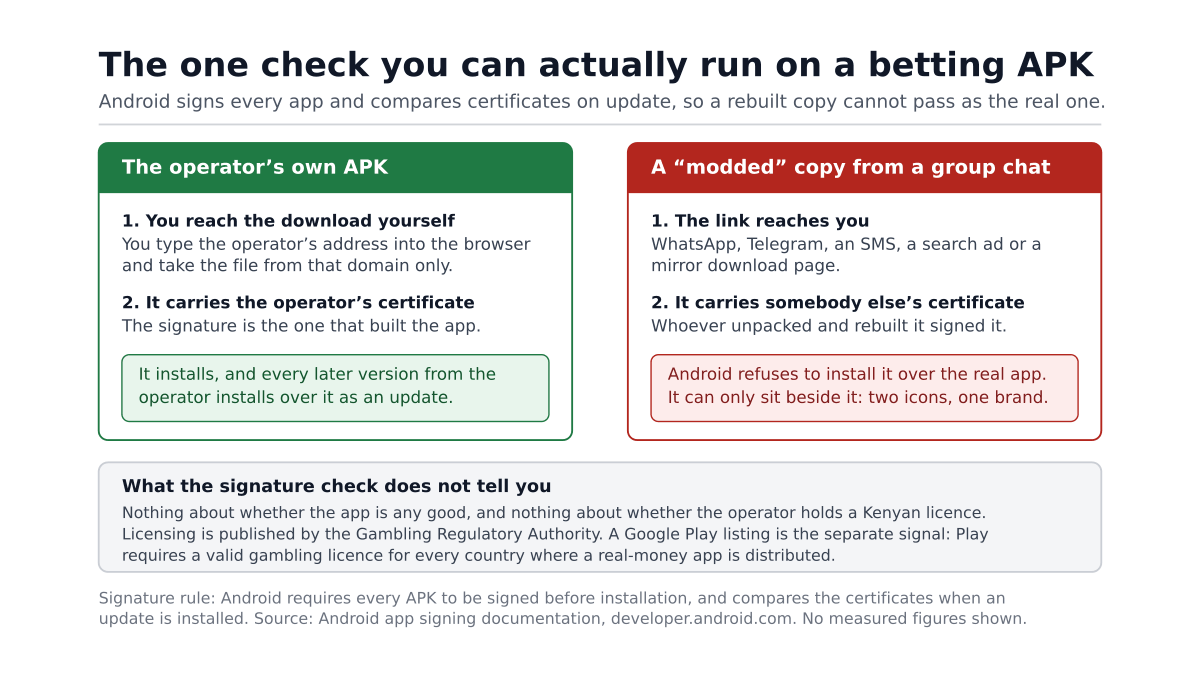
Which is the best betting app in Kenya is a question no page on the first results page can answer honestly, and that includes this one: producing a ranking means having used every app in it, and no operator has been tested here. What can be answered is the question sitting underneath it, the one that actually costs people money. You can check whether the app on your phone is the file the operator built, rather than a copy somebody rebuilt, and Android hands you that test for nothing.
Which is the best betting app in Kenya, and why does nobody answer it?
Search that phrase and you get two kinds of result: ranked lists with a number next to each name, and operators’ own pages. The lists look like measurements. Read one and you will rarely find what was measured, in what order the criteria were weighted, or on which handset, which makes them opinions arranged in a column rather than findings.
There is also a structural reason to read them slowly. Pages that rank betting apps are usually paid a commission on the accounts they send, this site included, which is why ours carries an affiliate disclosure and no ranking. That does not make a list dishonest. It does mean the order in a list is not, by itself, evidence about the apps.
The deeper problem is that “best” is not a property of an app. It depends on which leagues you bet, whether the thing runs on the phone you own rather than a flagship, what the withdrawal route costs you, and whether a Kenyan licence sits behind the company. Those pull in different directions, so a single ordering has to hide the trade offs to exist at all.
What does a genuine betting app mean when it never passed Play Store review?
Most international betting apps used in Kenya are installed from an APK file on the operator’s website instead of from Google Play, and the reason is written into Google’s policy. The Play policy on real-money gambling apps requires a developer to hold a valid gambling licence for each country or territory where the app is distributed, to complete an application process before distributing at all, and to block access from places the licence does not cover.
That has a consequence people skip past. If an app never went through Play, then “genuine” cannot mean “Google reviewed it”, because nobody did. It has to mean something narrower and checkable: the file you are installing is the one the operator signed, unmodified. Our guide to betting apps in Kenya and how to install an APK safely covers the install sequence and the permissions to refuse. This page is about the one step in it that is not a matter of judgement.
How does Android’s signature check expose a cloned or modded APK?
Android requires every APK to be digitally signed with a certificate before it can be installed, and when an update arrives it compares the certificate in the new file with the certificate in the version already on the phone. If they match, the update installs. If they do not, the Android app signing documentation is explicit that the new file must carry a different package name, which means the user installs it as a completely new app.
Whoever rebuilds a betting app to add something to it cannot sign it with the operator’s key, because they do not have it. So the signature stops matching, and that produces symptoms you can see on the phone, which is what the diagram above lays out.
Four things follow, and all of them are free.
Install the operator’s own file first, from an address you typed. Everything afterwards is measured against it. A download that begins on the operator’s domain and then redirects somewhere else has already failed, and you stop there.
Treat a failed install as information. If a file claiming to be a newer version of an app you already have refuses to install and Android reports that the app is not installed, the usual cause is that its certificate differs from the one on your phone. That is the check working, not the phone misbehaving.
Count the icons. Two entries for one bookmaker in your app drawer means two separate applications, signed by two different parties, sitting side by side. Only one of them came from the operator.
Keep Play Protect switched on. It scans apps installed from outside the store as well as from it, and it will warn you about known malware, so leaving it on costs nothing. Google’s documentation on Play Protect describes the checks it runs on apps from other sources.
One category deserves naming directly. Files advertised as modded, premium, cracked or unlocked, promising predictions or guaranteed wins, are never the operator’s app: no modification of a bookmaker’s software makes it pay out more than it owes, and the modification that was actually made is the part you are not being shown. The prediction half of that promise fails before the file itself does: in a crash game the round’s result is produced on the operator’s server before your phone is sent anything, which is why no Aviator predictor can read it in advance. On a phone that also holds M-PESA, an app with permission to read SMS is positioned next to your one time codes, which is what makes this the expensive mistake rather than an embarrassing one.
What does a Play Store listing tell you about a betting app in Kenya?
It tells you one useful thing, in one direction only. Because Play demands a valid gambling licence for every country where a real-money app is distributed, an operator whose app is available on Play in Kenya has had to show Google a licence for Kenya and pass an application process. That is a real signal and it costs you nothing to look for.
The reverse does not hold, and this is where the signal gets misread. An operator missing from Play in Kenya may simply not have applied, or may distribute its own way by preference. Absence proves nothing on its own, which is why the Play listing is a weak positive rather than a test.
For the question it does not settle, there is a primary source. Betting is legal in Kenya and licensed under the Gambling Control Act, 2025, so the real question is never whether betting is legal but whether a particular company is licensed, and what that changes about who deducts tax from a payout is set out on our page on betting tax in Kenya. The register itself is published by the regulator: the Gambling Regulatory Authority’s list of licensed companies carried 188 entries for the 2025/26 financial year when it was checked on 7 September 2026.
Are new betting apps in Kenya riskier than the popular ones?
Not because they are new. What changes with a new app is that you have no established idea of where its download is supposed to come from, so the first search result, the first ad or the first link in a group becomes the source by default. That is the gap a lookalike domain is built to fill.
Popularity cuts the other way as well. The more people search for an app, the more worthwhile it is to clone, so the best known brands attract the most convincing fakes. Neither newness nor popularity is the variable that matters. The variable is whether you arrived at the download by typing the operator’s address, and whether that address matches the one the company publishes on its own site and in its own communications.
What does this mean for the BetLabel app?
BetLabel distributes its Android app as a direct APK download from its own website rather than through Google Play, which is reported consistently across the independent bookmaker review databases this site works from. There is no native iOS app, so iPhone users are on the mobile website. The practical effect is that the Play signal described above is simply not available for it, and the signature check is the one that applies. The BetLabel app page sets out what is known about the distribution and what is not.
The separate question has a separate answer, and it is not a flattering one. BetLabel is not licensed in Kenya. It does not appear on the Gambling Regulatory Authority’s register, checked against that list on 7 September 2026, and the Curacao licence it holds regulates the company where it is registered rather than authorising it here. The consequence is jurisdictional: a Kenyan regulator can act on a company it licenses and cannot act on one it does not, which is worked through on our page on whether BetLabel is legal in Kenya. Verifying that an app is the operator’s genuine file and verifying that the operator is licensed are two different checks, and passing the first says nothing about the second.
Betting in Kenya is for adults aged 18 and over. If the download you are considering is the second or third betting app on the phone, the more useful question is not which one is best but whether an app should be there at all, and responsible gambling sets out the support available in Kenya and the practical steps that help.