
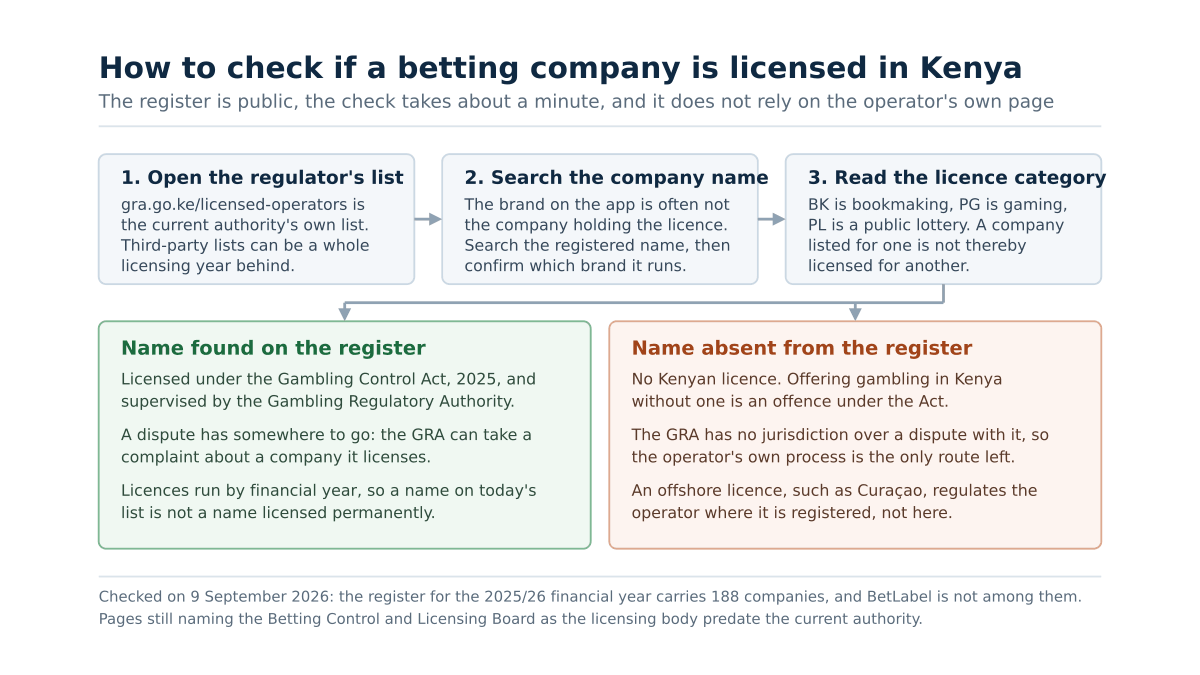
If you are looking for the list of licensed betting companies in Kenya, there is exactly one that matters, and it is not on an affiliate site. The Gambling Regulatory Authority publishes its own register of the companies it has licensed, and checking a name against it takes about a minute. This page explains what that licence actually is, how to run the check yourself, and why several of the lists competing with the regulator’s own page on that search are describing a system that no longer exists.
Who publishes the list of licensed betting companies in Kenya?
The licensing body is the Gambling Regulatory Authority, established by the Gambling Control Act, 2025. The text of the Act published by Kenya Law sets the rule plainly: a person shall not offer any gambling activity or service unless the activity or service is licensed under the Act. The GRA took over this work from the Betting Control and Licensing Board, with the handover completing in February 2026.
The register itself sits on the Gambling Regulatory Authority’s licensed operators page, headed “Gaming Operations Licensed Companies for 2025/2026 Financial Year”. Checked on 9 September 2026, it carried 188 companies.
This page does not reproduce that list, on purpose. A copy made today would start drifting from the register the moment a licence lapses or a new one is issued, which is precisely the failure that has already happened to most of the lists competing for this search. The register is public and searchable. Read it at the source.
Is betting legal in Kenya, or is it illegal?
Betting is legal in Kenya and it is licensed, which are two statements that have to travel together. The activity is lawful when the company offering it holds a licence under the Gambling Control Act, 2025, and unlawful when it does not. The Act is direct about the consequence: a foreign based gambling operator who provides online gambling services in Kenya without a licence commits an offence, and the penalties reach a fine of up to KSh 50 million for a corporation.
So the useful question is never “is betting legal in Kenya”. It is “is this particular company licensed”, and that has an answer you can look up rather than argue about.
How do you check whether a betting site is licensed?
Three steps, in the order shown in the diagram above, and none of them requires anything more than a phone.
Open the regulator’s register first. Not the operator’s own page, not a review site, not a PDF someone uploaded. An operator’s claim about its own licensing is the thing you are trying to verify, so it cannot also be the evidence.
Search the registered company name, not the brand. This is where most checks go wrong. Betting brands, apps and domains frequently belong to a company with a completely different name, so searching the name printed on the app can return nothing while the licence sits there under the parent company. Work in the other direction: find the company on the register, then confirm which brand it operates. A licensed operator normally publishes its licence details on its own site, and those two facts should agree.
Read the licence category. The register sorts companies into BK for bookmaking, PG for gaming and PL for lotteries. A company listed under one of those is not thereby licensed for the others, so a name appearing on the register is the start of the answer rather than the whole of it.
The check is hardest to read on a brand that has only just launched, where a name missing from the register has more than one possible explanation: how to check a new betting site is actually licensed before you join works through how to separate them.
Why do lists of legal betting sites in Kenya disagree with each other?
Because most of them were compiled under the previous regime and never updated. Search for licensed operators today and the results still include pages built around BCLB approvals, a Wikipedia entry for the Betting Control and Licensing Board, and at least one PDF of licensed companies from 2024. None of those are dishonest. They are simply older than the authority that now issues the licences.
There is a second reason, and it is structural. Licences are granted per financial year, so any list is a photograph of one moment. A page that was accurate when it was published becomes wrong without anybody editing it, which is why the register beats the summary every time. When comparing sites more broadly, the same principle applies to everything else on the page: our guide to choosing a betting site in Kenya works through the checks that stay reliable rather than the numbers that go stale.
How many betting sites in Kenya are actually licensed?
The register listed 188 companies for the 2025/26 financial year when it was checked for this page. That number answers a slightly different question from the one most people are asking, and the gap is worth understanding.
The register counts licensed companies, not websites, apps or brands. One company can operate a sportsbook, a casino and a mobile app under names that look like three separate businesses to a customer, while others hold a land-based licence that has nothing to do with an online product at all. So 188 is not a count of the betting sites you can reach from a Kenyan phone. It is the number of legal entities the regulator has licensed, which is the count that determines who has recourse if a payout stalls.
The number also moves in both directions. New licences are issued and existing ones lapse or are revoked, so it will not be 188 indefinitely, and any page still quoting a figure from an earlier licensing year is quoting a fact with an expiry date on it. The overview of betting sites in Kenya covers what the licensed side of the market looks like in practice.
Is BetLabel a licensed betting company in Kenya?
No. BetLabel does not appear on the Gambling Regulatory Authority’s register, checked name by name on 9 September 2026. The operator is run by TechSolutions Group N.V. and holds a Curacao licence, and a Curacao licence regulates the company where it is registered. It is not a Kenyan licence and it does not stand in for one.
There is a reason a name can be absent from the register rather than merely slow to join it. Under the Act, a foreign operator can be licensed in Kenya only if it is registered in Kenya, has a physical address here, and meets the GRA’s requirements including audited accounts. That is a local establishment test rather than a paperwork formality, and it is a route that is open: international brands do appear on the register, listed under the name of a Kenyan company that holds the licence for them. An operator that has not taken that step does not appear at all.
We state this because it is checkable and because the alternative, quietly omitting it, is what the affiliate pages ranking for this query tend to do. The fuller version of the argument, including what the missing licence changes and what it does not, sits on our page on whether BetLabel is legal in Kenya, and the operator’s product and its weak points are set out in the BetLabel review.
What does an unlicensed operator actually change for you?
Three things, and none of them is a moral point.
The first is jurisdiction. The GRA supervises companies it licenses and can take a complaint about them. It has no authority over a company it has not licensed, so a dispute with one of those is settled inside the operator’s own process, and if that process disappoints you there is no Kenyan body to appeal to.
The second is the set of obligations that come attached to a Kenyan licence. Licensed operators are required to provide self-exclusion so that a player can bar themselves, and to have their platforms certified and periodically tested. Those requirements exist because the harm they address is real. An operator outside the framework may offer the same protections voluntarily or may not, and in BetLabel’s case independent reviewers have criticised the absence of a clearly signposted responsible gambling page, directing users to customer support instead.
The third is advertising. Gambling advertising in Kenya must be approved by the GRA, and the Gambling Control (Licensing) Regulations 2026 analysed by CM Advocates put prize competitions and promotional campaigns under separate licensing and compliance requirements on top of that. So the volume of promotion around an operator tells you something in itself. A campaign running inside the Kenyan framework has been through an approval that a campaign running outside it has not.
Betting in Kenya is for adults of 18 and over. If the amount going into stakes has started to reach rent, fare or school fees, the licence question is not the most important one on the page, and responsible gambling sets out the support available in Kenya and the practical steps that help.