
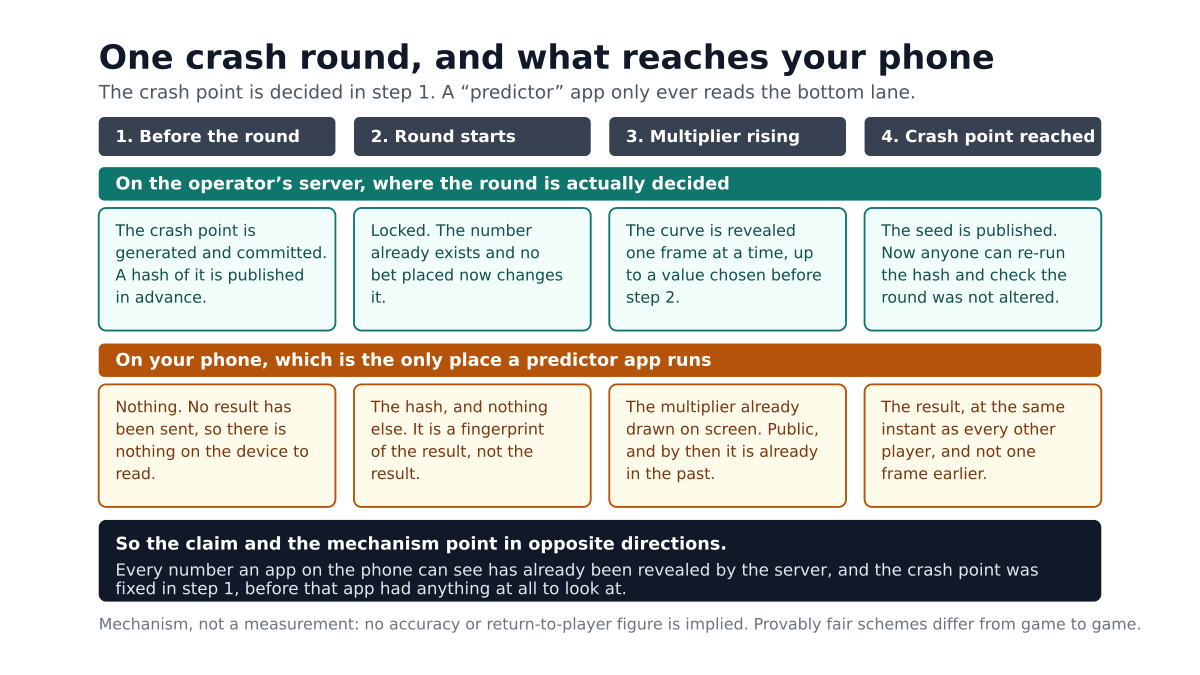
No aviator predictor is real, and the reason is a timing problem rather than a judgement about who is honest. In a crash game the result of a round is generated on the operator’s server, and your phone is only shown that number once it has already been decided. An app sitting on the phone is therefore reading an output at the same instant every other player sees it, and there is no earlier moment available for it to read. Everything else about these apps follows from that one fact.
Is the aviator predictor real, or does it only look like it is?
The material that sells these apps is convincing in a specific and repeatable way: it is always retrospective. A video shows a prediction beside a round that has already finished, a group chat posts the call that landed, and nothing in either format requires the prediction to have existed before the result did.
That is the structural problem with the evidence rather than a claim about any particular seller. A prediction is only testable if it is recorded before the round opens and then scored against every round that follows, misses included. Promotional material for these apps does not work that way, and the ones circulated in group chats have an additional filter on them: the calls that failed are not the ones anybody forwards. The same shape appears wherever something is sold on its results in this market, which is why our page on betting tips in Kenya treats an unrecorded claim as no claim at all.
How does the Aviator game work, and where does the multiplier come from?
A crash game draws a multiplier that climbs from 1.00 upwards and stops at a point chosen for that round. You cash out before it stops or you lose the stake. The part that matters is where the stopping point comes from, and it is not the animation. The curve on your screen is a drawing of a number that already exists on the server.
In a provably fair implementation the game goes further and commits to the result in advance. Before the round opens it generates the crash point from a seed, publishes a hash of that seed, and releases the seed itself once the round has ended so anyone can re-run the calculation and confirm nothing was changed midway. Implementations vary between games, but the direction of travel does not: the result is fixed first, the reveal comes second, and the hash you receive beforehand is a fingerprint that tells you nothing about the number it fingerprints. The diagram above lays the two lanes side by side.
Great Britain’s remote technical standards on the generation of random outcomes set out what a certified random game is built to do, and the requirement on random number generation closes both doors at once. The output “should be unpredictable”, which the standard itself glosses as computationally infeasible to predict without complete knowledge of the algorithm and the seed value, so nothing downstream can work the result out in advance. And “adaptive behaviour (that is, a compensated game) is not permitted”, so the game is not watching your stakes and adjusting, which means it is not holding back a payout it owes you either.
How does an aviator predictor app claim to work, and what is it doing instead?
For an app on your handset to predict a round, it would need one of three things, and each one can be checked.
The seed before the reveal. The server holds it and publishes it afterwards. Nothing sends it early, so an app cannot hold it early.
A weakness in the number generation. Suppose one existed. Exploiting it would still require the seed and a great deal of computation, and anyone who had managed it would use it quietly rather than sell an app about it. A working exploit is worth more than any subscription list.
Pattern in the previous rounds. Each round is drawn fresh from its own seed, so an earlier crash point carries no information about the next one. A long run of low multipliers does not make a high one due. This is the gambler’s fallacy, and a screen full of past results is precisely the surface that makes it feel like data.
What the apps can genuinely do is read your screen and draw on top of other apps. Those two permissions are enough to display a number over the game and make it look integrated, and they are also what an overlay built to capture a login needs. So a phone that holds M-PESA and a betting account has just granted screen access to a stranger’s software. An app that then asks for the betting account username and password is not asking for something it needs to predict anything: it is asking for the account.
Does Aviator have a strategy that changes what you get back?
Not in the sense the question usually means. Your cash-out target changes the shape of your results and not the long-run return. A low target lands often for small amounts, a high target lands rarely for large ones, and the operator’s margin is taken either way. No auto cash-out setting, stake progression or pattern of rounds alters an outcome that was fixed before you staked.
The pattern worth naming is doubling after a loss. It survives on paper because it assumes a bankroll with no bottom and a stake limit with no ceiling, and it fails in practice for the ordinary reason that both run out, usually on the same losing run.
Return to player belongs in the same category. It is a long-run average across an enormous number of rounds, which means it describes the game rather than your session, and a single round is not an average of anything. This site does not publish an RTP figure for any specific crash title, because we have not been able to verify one against a source we can stand behind, and a percentage typed in from memory would be a decoration pretending to be a measurement.
Which aviator predictor app is best, and what does installing one cost?
None of them, and the question hides a more expensive one. Every app of this kind is distributed outside Google Play, because Play does not admit it, which means the file arrives as an APK from a download site, a Telegram channel or a link in a group.
That route has consequences you can reason about without trusting anyone. The file is not signed by the bookmaker whose brand it borrows, so the signature check that would normally tell you a betting app is genuine has nothing authentic to compare against, a mechanism we set out in our article on checking that a betting app is the operator’s own file. The permissions to read the screen and to install from unknown sources are granted to software nobody has reviewed. Our guide to betting apps in Kenya covers the install sequence and the permissions worth refusing, and it applies with more force here, since a predictor app has no legitimate reason to exist on the phone in the first place.
What does Kenyan law require of the games a licensed operator runs?
Kenya regulates gambling rather than banning it. Under the Gambling Control Act, 2025, section 28(1) provides that a person shall not offer any gambling activity or service unless the activity or service is licensed under the Act, and section 28(2) sets out the categories the Authority licenses separately. Online gambling is one of them, the provision of any gambling software or platform is another, and gambling equipment testing is a third. Section 44 requires that machines used by a licensee be sourced from a certified source with international certification standards and undergo standards verification after every three months. Section 87(1) adds that a person shall not promote the advertisement of a gambling activity on electronic media without the Authority’s approval.
The point for a reader looking at a crash game is that every one of those duties attaches to a Kenyan licence and to nothing else. Where there is no Kenyan licence, the platform behind the game falls outside the categories the Authority licenses at all, and no Kenyan regulator has a dispute to hear about what it does. The Gambling Regulatory Authority’s register of licensed operators held 188 companies for the 2025/26 financial year when it was checked on 7 September 2026.
BetLabel is not among them, which is the single most important thing to know before reading anything else about it, and the Curacao licence it holds regulates the company where it is registered rather than authorising it here. What that changes about recourse is worked through on our page on whether BetLabel is legal in Kenya. Its casino section is recorded in the sources this site works from as carrying slots, live dealer tables, poker, bingo and virtual games; whether it lists a crash title is not something we have been able to verify, so we do not state it, and the BetLabel casino page sets out what is known and what is not.
Betting and casino play in Kenya are for adults aged 18 and over. If a predictor app looked appealing because a session has gone badly and something needs to make the next one different, that is the part worth acting on rather than the app, and responsible gambling lists the free support available in Kenya and the practical steps that help.