
Look up the sure odds meaning and you get two different answers wearing one phrase, and in betting arithmetic there is no such category. A price is a probability with the bookmaker’s margin added on top, and a probability short of 1 is not a certainty. On Kenyan tipster sites, in Telegram channels and in WhatsApp groups the phrase means something far more specific, which is a selection somebody is charging you for, and the thing being sold there is the appearance of certainty rather than certainty itself.
What does sure odds mean, and is it a real betting term?
It is not a term any bookmaker uses about its own market, and you will never see it printed beside a price the house itself publishes. The vocabulary on the pricing side is narrower: a selection is odds-on when it is priced below 2.00, which means the market rates it more likely than not, and that is as close to confidence as a published price gets. Nothing in that vocabulary reaches certainty, because certainty would be a price of 1.00, and a price of 1.00 pays back exactly what you staked. No bookmaker publishes that market, for the same reason no shop sells a hundred-shilling note for a hundred shillings.
So the phrase lives entirely on the selling side. “Sure odds today”, “sure odds predictions” and “buy sure odds” are so-called categories that exist only inside the advert, and they do what product names do, which is describe the promise rather than the thing. The promise is attractive precisely because the honest version is uncomfortable: the price you are offered already contains everything the market knows, and a stranger with a phone does not hold anything it left out.
Why does no price add up to a certainty, and why does the house always win in sports betting?
Because of the margin, and it is visible in any price if you convert it back into a probability. Take a two-way market where both sides are priced at 1.90. This shape is used here only to show the arithmetic, not as a quote of anything real. One divided by 1.90 is 0.5263, so each side implies a 52.63 per cent chance. Add them and you get 105.26 per cent. Certainty is 100 per cent, so the market is carrying 5.26 percentage points that belong to nobody’s chance of winning. That is the bookmaker’s margin, and it is the only part of the transaction that is genuinely sure.
Put shillings on it. Back both sides of that market for KSh 100 each and you have staked KSh 200. Whichever side comes in, KSh 190 comes back. The KSh 10 gap is charged on every bet placed into that market, including the ones that win, which is the whole answer to why the house comes out ahead over time. Nothing is being rigged. A small fixed cost is applied to every transaction, and volume does the rest. How wide that margin runs at particular Kenyan bookmakers is not something we have measured, and our page on BetLabel’s odds sets out what is and is not known there.
Kenyan tax sits on top of that arithmetic rather than inside it. On a locally licensed operator, excise duty of 5 per cent applies to amounts wagered, and withholding tax of 20 per cent applies to winnings calculated after your stake is deducted. Both are explained in full on our page about betting tax in Kenya. The point here is narrow: a selection would have to clear the margin and then the tax before “sure” and “profitable” meant the same thing.
Are “sure bets” the same thing as sure odds?
No, and conflating the two is worth some trouble to avoid, because one of them is a real technical term. Arbitrage, which the industry shortens to a “sure bet” or a “surebet”, is the situation where two bookmakers disagree about a price by enough that backing every outcome across both of them returns more than the total staked. It has nothing to do with knowing a result: it is a pricing discrepancy between two companies, and it disappears the moment either of them moves.
That is a different claim from the one a tipster makes. Arbitrage requires no forecast, no inside information and no subscription, which is exactly why nobody sells it to you as a tip. When a channel offers “sure bets today”, it is borrowing the credibility of a term that means something else.
How are sure odds and betting tips actually sold in Kenya?
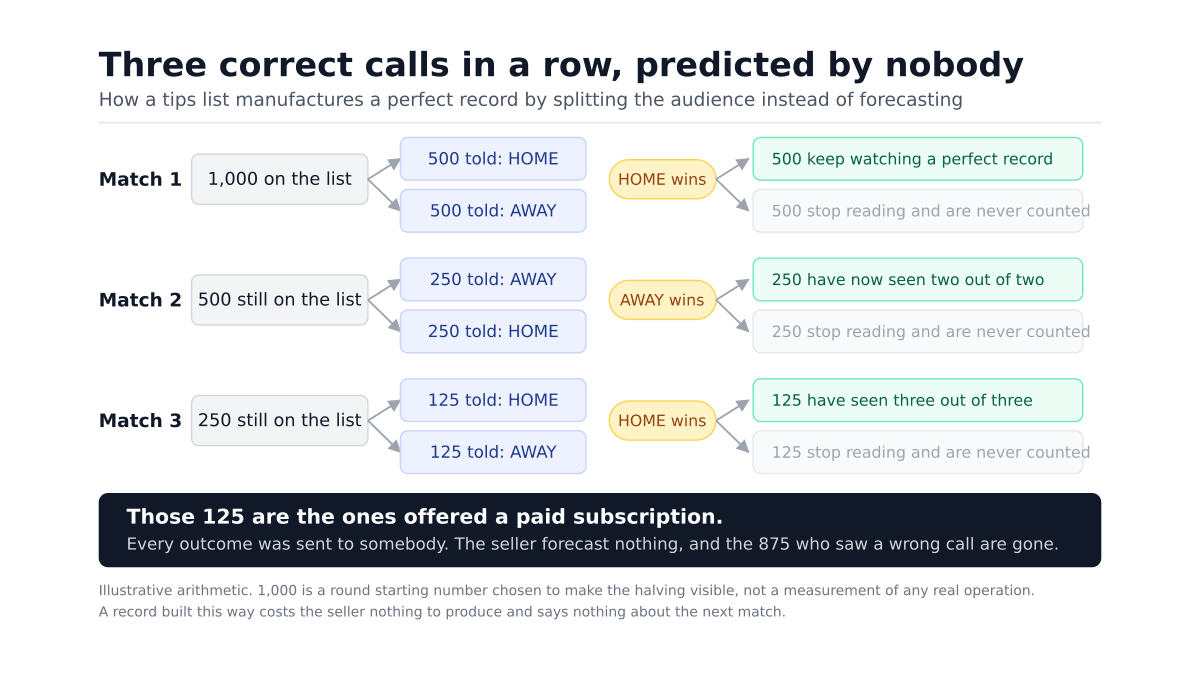
By showing you a record, and a record of this kind is the cheapest thing on the page to produce, which is why it can never be read at face value. The diagram above sets out the mechanism. Split a list of 1,000 people in half before a match, send one half the home win and the other half the away win, and afterwards 500 people have watched a correct call. Split those 500 and repeat, then split the 250 and repeat again. After three matches, 125 people have seen three correct calls in a row, and they are the ones who get offered the paid subscription. The seller forecast nothing. Every outcome was sent to somebody, and the 875 who saw a wrong call are no longer reading.
That is the deliberate version. The ordinary one needs less effort, because survivorship produces the same effect for free: post enough calls publicly, screenshot the ones that land, and let the rest scroll away. A winning slip is a photograph taken after the result, which is why it proves nothing about the moment before it.
Two other things are worth watching. The seller’s income does not depend on the outcome, so a losing week costs them a few unsubscribes and nothing else, while it costs you the stake. And when a list of any size backs one selection, the price on it shortens, so the odds quoted in the advert are not the odds most buyers get. Our guide to betting tips and how to read a claimed record goes through the sales patterns in more detail, including the “free tip today, pay for tomorrow” funnel that most of these operations run on.
What about fixed matches, and why is buying one worse than useless?
Begin with what the seller is claiming to hold, because every reading of that claim ends in fraud of one kind or another. FIFA defines match manipulation as the unlawful influencing or alteration, directly or by an act or omission, of the course, result or any other aspect of a football match or competition, and it is pursued by the sport’s own governing bodies as an integrity matter. That definition is the useful part, because it tells you what somebody is claiming when they offer to sell you one, and the claim collapses in both directions.
Either the seller has no involvement in any such arrangement, in which case they are selling you a story, or they are claiming to have it, in which case they have told you they are part of a corruption scheme and are asking you to send money to a person who has just described themselves that way. There is no third reading in which you are the person who benefits. A genuine arrangement of that kind is also not a retail product: the people involved in one have no reason to dilute it by selling entries to strangers on the internet for a fee.
We do not publish predictions, scorelines, “sure” selections or fixed-match claims anywhere on this site, including as worked examples, and our page on football betting in Kenya covers the markets themselves rather than what will happen in them. Jackpot cards attract the same claims in the same language, and our guide to how a SportPesa jackpot card is scored counts the possible completed cards, which is the number a seller of certainty needs you not to work out.
What does Kenyan law say about an advert that promises a certainty?
Gambling is legal and regulated in Kenya, and the rules are specific about advertising. Under the Gambling Control Act, 2025, section 87(1) provides that a person shall not, without the approval of the Authority, promote the advertisement of a gambling activity on electronic medium or any other form of communication. Section 87(2) then constrains what an approved advertisement may say, and one requirement is that it must not use a false, misleading or deceptive message likely to create an erroneous positive impression of gambling. Section 28(1) is broader still: a person shall not offer any gambling activity or service unless the activity or service is licensed under this Act.
The gap a reader should notice is who those duties actually reach. They attach to licensees and to gambling advertising, and the person running a tips channel is not on any register you can look up. The Gambling Regulatory Authority’s register of licensed operators held 188 companies for the 2025/26 financial year when it was checked on 7 September 2026, listed under bookmaking, gaming and lottery categories. Checking a bookmaker against that list is a real test that takes a minute, and our guide to choosing a betting site in Kenya walks through it. Checking a tipster against it is not possible, because there is nothing there to check.
The same list is how the position of an offshore operator is established rather than assumed. BetLabel does not appear on it, so it is not licensed in Kenya, and the Curacao licence it holds regulates the company where it is registered instead of authorising it here. What that means for anyone with a dispute is worked through on our page on whether BetLabel is legal in Kenya, and it is the first thing to settle before any question about odds or offers.
Betting in Kenya is for adults aged 18 and over. If the reason a “sure” selection looked worth buying is that a run of losses needs to be recovered, that is the part worth acting on rather than the offer, and responsible gambling lists the free support available in Kenya alongside the practical steps that help.