
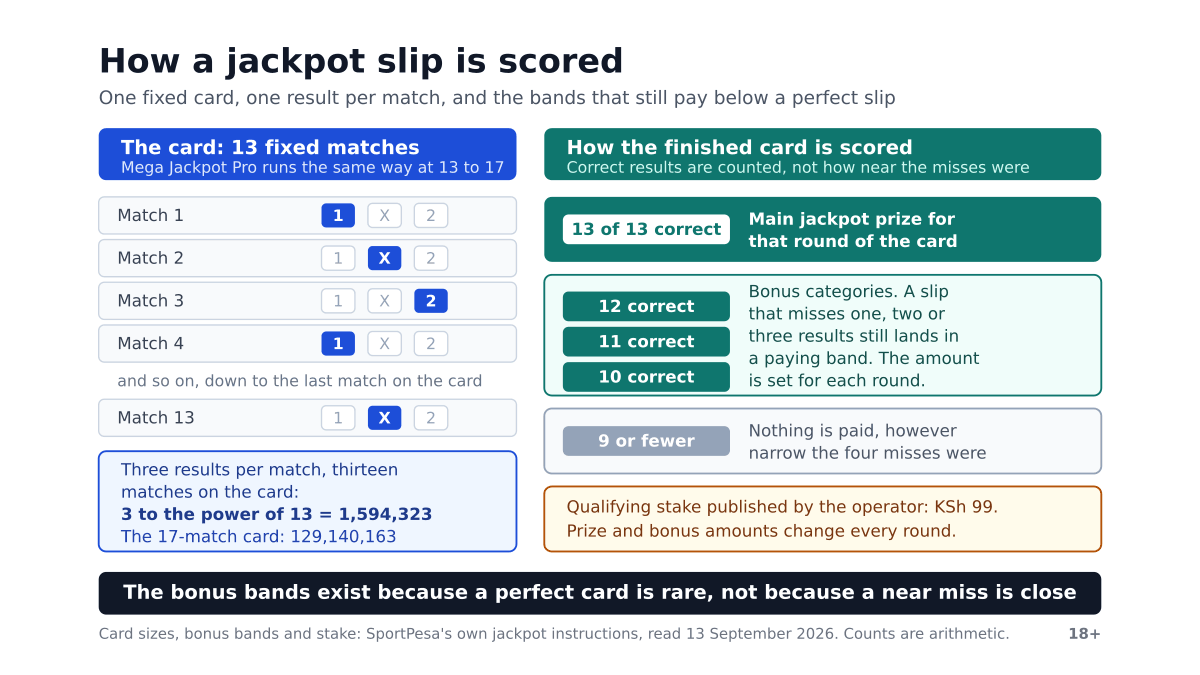
How does SportPesa jackpot work? The operator publishes a fixed list of football matches, you predict the full-time result of every match on that list, and the completed card is scored on how many of those results you got right. You do not choose the fixtures and you do not stake each match separately. The whole card is one entry, and the thing that separates a jackpot from an ordinary multi-match slip is that falling short of a perfect card does not automatically mean falling to nothing.
How does SportPesa jackpot work once the card is published?
The card comes first, and it is not yours to edit. SportPesa selects the fixtures, and your only input is the full-time result on each one: 1 for a home win, X for a draw, 2 for an away win. The Midweek Jackpot card carries 13 pre-selected matches and the qualifying stake published for it is KSh 99.
The Mega Jackpot is where most of the confusion sits, because it is not one game. SportPesa’s own instructions describe it as five jackpots inside one card: Mega Jackpot Pro 17, Pro 16, and the 15, 14 and 13 game versions. They are drawn from the same published fixture list, and each one is its own game with its own prize. Entering the 13-game version does not mean you have entered the 17-game version with four blanks. It means you played a different game.
Kenyan law has its own definition of what you are entering, and it is narrower than the everyday use of the word. Under the Gambling Control Act, 2025, a jackpot is the highest prize from a combination of letters, numbers or symbols in a game of chance, payable either from a fixed prize schedule or from accumulating contributions. The practical half of that definition is the payment basis: the prize is either a figure set in advance or a pot built from entries, which is why the amount on offer changes from one round to the next and why no article can honestly print a current figure.
Why is a perfect card so hard, and where does that arithmetic come from?
Count the possible completed cards. Thirteen matches with three possible results each gives 3 multiplied by itself 13 times, which is 1,594,323 different ways a card can be filled in. The 17-match version gives 129,140,163. Both are redoable on a phone calculator, and both are the reason the bonus bands exist at all.
Those numbers are not the odds of winning, because football results are not equally likely: a strong home side is not one chance in three. What the count shows is the size of the space a single card has to land in, which is why the structure pays out below a perfect result. Without bands, a round in which nobody produced a perfect card would pay nobody anything.
It settles something else too. Nothing about the size of that space tells you which combination is coming, and no method of filling in the card changes the result of a match. We do not publish predictions, jackpot tips or claimed winning combinations anywhere on this site, and our page on how betting tips are actually sold in Kenya explains why the ones you are offered for a fee are worth reading sceptically.
How is the SportPesa jackpot bonus awarded?
By counting correct results, not by judging how close the misses were. On the 13-match Midweek Jackpot, the operator’s instructions list bonus categories for 12, 11 and 10 correct selections alongside the main prize for all 13. The Mega Jackpot Pro games work the same way at their own sizes, with the published example of the 13 game version paying bonuses at 10, 11 and 12 correct, and the 14 game version paying at 10, 11, 12 and 13.
The diagram above sets out the shape of it. One band takes the main prize, three bands below it take a bonus, and everything under the lowest band pays nothing at all, whether you missed by four results or by thirteen. A card sitting one result outside the lowest paying band is not nearly a winner in any sense the scoring recognises.
What the instructions do not give is an amount, and neither will we. Bonus amounts are set by the operator for the round in question, so a figure copied from an article written months ago is not a smaller version of the truth, it is a different round’s number. Read the current card.
How do you bet a SportPesa jackpot via SMS?
SMS is a submission channel, not a separate product or a shortcut to better terms. The card you send by message is the same card, scored the same way, against the same fixtures.
For the Midweek Jackpot, the published format is JP followed by your 13 selections, sent to 79079. Quick Pick works from the same shortcode: send JP#? and the system generates the 13 selections for you. For the Mega Jackpot the prefix is MJP, with the selections separated by the hash symbol and 0 marking a match you are not selecting, which is how the shorter Pro games are entered from the same 17-match list. SportPesa’s published example runs MJP#X#2#1#X#2#2#1#0#X#0#1#X#X#1#1#2#0.
The reason SMS still matters is not nostalgia. It works on any handset, on a weak connection, without an app install and without a browser session. One practical consequence follows from the format itself: a mistyped selection inside a string of 13 or 17 characters does not look wrong the way a wrong tap on a screen does, so the message is worth rereading before it goes.
Can you cancel a jackpot bet after you have placed it?
This one deserves a straight answer rather than an invented procedure. The instructions SportPesa publishes for placing a jackpot bet set out how to submit the card, not how to withdraw one, and we have not been able to verify any published cancellation route. So we are not printing steps for one.
The structure suggests why a jackpot entry is not an easy thing to unwind. Each card is an entry into a round against a fixed fixture list that closes before the first match starts, and where the prize is payable from a schedule or from accumulated contributions, entries are part of what determines the payout rather than standalone bets the operator can quietly reverse. If you need to know an operator’s actual position, ask its support in writing and keep the reply, which is the same advice we would give about any term that matters and is not published.
How does accumulator betting work, and is a jackpot the same thing?
An accumulator, which Kenyan bettors usually call a multibet, is several selections combined on one slip where the odds multiply together. Three selections priced at 2.00 each produce 2.00 times 2.00 times 2.00, which is 8.00, and those prices are illustrative arithmetic rather than a quote of any real market. Every leg has to land. One loss and the whole slip returns nothing, which is the defining feature of the format and the reason long multibets look so attractive on the payout line.
A jackpot is a different animal in three ways. The fixtures are chosen for you rather than by you. There are no per-leg prices multiplying up, because the prize comes from the round’s schedule or pot rather than from your selections’ odds. And partial success is recognised, which never happens on an accumulator. Set against that, an accumulator lets you pick your own matches and see your potential return before you stake, while a jackpot card gives you neither.
The bookmaker’s margin is the part both formats share, and on an accumulator it is charged once per leg rather than once per slip, so it compounds as the slip grows. How wide that margin runs at particular operators is not something we have measured, and our page on BetLabel’s odds sets out what is and is not known there. The ordinary markets these cards are built from, along with what a full-time result market actually covers, are explained in our guide to football betting in Kenya.
Who handles the tax on a jackpot win, and what changes on an unlicensed site?
The operator’s licence status decides who deals with the tax, and it is checkable in a minute. SportPesa appears on the Gambling Regulatory Authority’s register of licensed operators, listed under Milestone Games Limited against bookmaking licence 0001193, in a register holding 188 companies for the 2025/26 financial year when we checked it on 13 September 2026. An operator in that position is inside the Kenyan tax machinery: withholding tax of 20 per cent applies to winnings, calculated after your stake is deducted, and excise duty of 5 per cent applies to amounts staked. Both are set out in full on our page about betting tax in Kenya.
An operator that is not on that register sits outside the machinery, and the consequence is regularly described backwards. BetLabel does not appear on the register, so it is not licensed in Kenya, and its Curacao licence regulates the company where it is registered rather than authorising it here. Nothing is deducted at payout on an operator in that position, and that is not an exemption: the deduction simply never happened, so the obligation to account for the money remains with the person who received it. What that means for a dispute, where there is no Kenyan regulator to hear one, is worked through on our page on whether BetLabel is legal in Kenya.
One point specific to this article’s subject. We looked for a Kenyan-style weekly football jackpot at BetLabel, of the sort described above, and did not find one documented. Our operator data records that as unverified rather than as an absence we have proved, and nothing on this page should be read as saying the product exists there. Checking what an operator actually offers, against its own site and against the licensed register, is the first step in choosing a betting site in Kenya.
Betting in Kenya is for adults aged 18 and over. A jackpot card is a low-cost entry with a very large space of possible outcomes, which makes it easy to enter every round without noticing the total, and responsible gambling sets out the free support available in Kenya alongside the practical steps that help.